
Vectorlight News

  • Chat App Converted to HTML and JQuery
    Sep 08, 2011

    Converted from Silverlight to HTML and Javascript/JQuery is the Vectorlight Chat App. Login using your Vectorlight password to chat using your username and avatar.

  • HTML5 iPhone,Android Big Guns Tower Defense
    Jul 02, 2011

    Big Guns has made the leap from Windows Phone 7 (XNA) to HTML5 so you can now play it on your iPhone, Android and other HTML5 compatible devices.

  • HTML5 Games - Word Poppers and Batty
    Jun 04, 2011

    As the take-up of HTML5 quickens (74% of users currently have a browser capable of HTML5 Canvas) we present two more games for both your browser and mobile.

  • Big Guns Tower Defense on Windows Phone 7
    May 06, 2011

    Coming soon to Windows Phone 7 is an XNA port of the popular Vectorlight tower defense game Super Tower Defense. Whilst retaining many of the graphical and gameplay features of the original Silverlight game.

  • Wakacube WP7 Update
    Apr 26, 2011

    Released to the Windows Phone 7 marketplace today is Version 1.1 of Wakacube the 3D physics game of skill. Included in the update are more levels (30 in total) and new mode Wakatime which generates random crate structures to keep players entertained long after the levels have been completed.

  • Home Page News

Using XML in Silverlight

XML is an important medium in the world of Silverlight especially where Web Services are involved.  The .NET 3.5 that comes with Silverlight omits some of the core XML objects that you will find in the full incarnation of .NET 3.5.  There is however the XML Reader and Writer classes that allow you high speed access to reading and writing XML documents.  In our sample on this page we use an XML reader to read a simple XML file and render the results to the page.
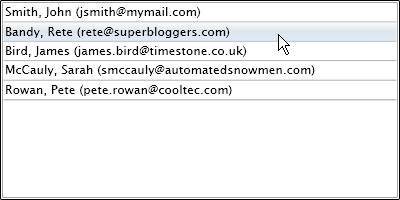
Our example XML Customer List


Our example XML file looks like this, as you can:

<?xml version="1.0"?>
<customers>
    <customer id="10001" first="John" last="Smith" company="Donuts plc">jsmith@mymail.com</customer>
    <customer id="10002" first="Rete" last="Bandy" company="This Is Bloggers Co.">rete@superbloggers.com</customer>
    <customer id="10003" first="James" last="Bird" company="Timestone">james.bird@timestone.co.uk</customer>
    <customer id="10004" first="Sarah" last="McCauly" company="Automated Snowmen Ltd">smccauly@automatedsnowmen.com</customer>
    <customer id="10005" first="Pete" last="Rowan" company="Cooltec Consultants">pete.rowan@cooltec.com</customer>
</customers>


The XAML for this tutorial is very simple, we just have one listbox and is as follows:

<UserControl x:Class="XMLTutorial.Page"
    xmlns="http://schemas.microsoft.com/winfx/2006/xaml/presentation"
    xmlns:x="http://schemas.microsoft.com/winfx/2006/xaml"
    Width="400" Height="300">
    <Grid x:Name="LayoutRoot" Background="White">
        <ListBox x:Name="customersList" Width="400" Height="200" />
    </Grid>
</UserControl>


In our XAML we have only one ListBox for this tutorial, all the processing is done in your C# code behind:

using System;
using System.Collections.Generic;
using System.Linq;
using System.Net;
using System.Windows;
using System.Windows.Controls;
using System.Windows.Documents;
using System.Windows.Input;
using System.Windows.Media;
using System.Windows.Media.Animation;
using System.Windows.Shapes;
using System.Xml;

namespace XMLTutorial
{
    public partial class Page : UserControl
    {
        public Page()
        {
            InitializeComponent();

            PopulateCustomersList();
        }

        private void PopulateCustomersList()
        {
            XmlReader reader = XmlReader.Create("Customers.xml");

            reader.MoveToContent();

            while (reader.Read())
            {
                if (reader.NodeType == XmlNodeType.Element && reader.Name == "customer")
                {
                    customersList.Items.Add(new ListBoxItem() { Content = reader.GetAttribute("last") +
                        ", " + reader.GetAttribute("first") + " (" + reader.ReadInnerXml() + ")" });
                }

                if (reader.NodeType == XmlNodeType.EndElement && reader.Name == "customers")
                {
                    break;
                }
            }

            reader.Close();
        }
    }
}


In the above code we enter a while loop reading each Customer element and outputting the First, Last names and email address.

Your Comments

Alina posted

For me it goes ok while I run from Visual Studio, but if I try to open just the TestPage, it does not read my xml file...  do you why this happens?


Pappu posted

How to acess the xml data of sqlserver in silverlight application.


Gautam posted

Will it accessible if the xml is not in clientbin folder..how i will access the xml file if file is not in clientbin folder


dan posted

Hi Daniel,


Thanks for pointing this out, it has been removed.


dan posted

Hi Keysle,


The XML file goes in the root of your project (the same as the xaml files) and included in your project as Content.  The code which you can download above shows this.


Thanks!


Daniel posted

Why did you create the settings which you never add to your XmlReader?


Keysle posted

I'm haveing trouble figuring out where the XML file goes. where does it go? the client bin?


Post your Comments

Rate this: 

1 Star 2 Star 3 Star 4 Star 5 Star
24 Ratings / 4.0 Average

Tweets

Silverlight Controls

  • Rich TextBox

    Create and edit rich content with this slick and expandable Rich TextBox...

  • TreeView

    This easy to use TreeView comes with drag and drop, sorting, searching and much more...

  • Context Menu

    You too can have cool popup context menus in your Silverlight applications...

  • Resizable Dialog

    Draggable and resizable popup dialogs are what serious Silverlight developers need...

  • Spell Checker

    Real-time spell checking in Silverlight? We did it first here...